

Nature as Performance Medicine: Why Elite Athletes Are Returning to Outdoor Training Environments
The most sophisticated training facilities in the world feature climate-controlled environments, precision equipment, and real-time biometric monitoring. Yet something curious is happening among elite athletes and serious fitness practitioners: they’re deliberately choosing to train outdoors. This isn’t nostalgia or rejection of technology. It’s recognition of something performance science is finally quantifying—nature provides physiological advantages that indoor environments simply cannot replicate.
Consider this: professional endurance athletes training at altitude don’t just benefit from reduced oxygen availability. The natural terrain, varied visual input, temperature fluctuations, and circadian rhythm alignment all contribute to adaptations that controlled environments miss entirely. When we isolate single variables in laboratory-perfect conditions, we eliminate the complex biological signals that trigger optimal human performance. Nature isn’t just where we train. For the human body, nature is the training stimulus our physiology evolved to respond to most effectively.
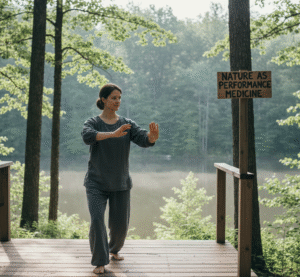
The Neurological Advantage: How Natural Environments Enhance Athletic Performance
Your nervous system operates differently outdoors, and this difference directly impacts performance capacity. When you train in natural environments, your brain processes information through multiple sensory channels simultaneously—visual complexity from varied terrain, auditory input from environmental sounds, proprioceptive feedback from uneven surfaces, and olfactory signals from plant compounds in the air. This multi-channel processing creates what researchers call “soft fascination,” a state where attention is engaged but not overtaxed.
The performance implications are significant. Studies indicate that athletes who incorporate outdoor training sessions demonstrate improved decision-making speed, enhanced spatial awareness, and better stress management under competitive pressure. The mechanism involves attention restoration theory—natural environments allow the prefrontal cortex to recover from directed attention fatigue while maintaining engagement. This is fundamentally different from rest or distraction. Your brain actively processes environmental complexity while simultaneously reducing the cognitive load that accumulates during intense training.
The neurological benefits extend to motor learning and skill acquisition. Research from sports science laboratories suggests that learning complex movement patterns in variable outdoor environments produces more robust motor programs than training in controlled indoor spaces. When you learn a movement while adapting to wind, uneven ground, and changing light conditions, your nervous system builds flexibility into the motor pattern itself. This translates to better performance transfer when competition conditions vary from training conditions.
Hormetic Stress and Adaptation: Why Natural Training Environments Build Resilience
Elite athletes understand that adaptation comes from strategic stress exposure followed by recovery. Natural environments provide a unique form of hormetic stress—beneficial stressors that trigger adaptation without causing damage. The temperature variations, UV exposure, terrain irregularity, and even exposure to environmental microorganisms all function as hormetic stressors that enhance physiological resilience.
Temperature fluctuation deserves particular attention. When you train outdoors, your body constantly makes micro-adjustments to maintain thermal homeostasis. This isn’t merely discomfort—it’s metabolic training. Research demonstrates that regular exposure to temperature variation improves mitochondrial function, enhances brown fat activation, and strengthens thermoregulatory efficiency. Athletes who train exclusively in climate-controlled environments miss these adaptations entirely. The result shows up in competition when environmental conditions shift unexpectedly.
The microbial exposure from natural environments also contributes to performance capacity through immune system modulation. Contact with soil microorganisms and diverse outdoor bacteria trains your immune system to distinguish between threats and benign environmental signals. This reduces systemic inflammation and improves the immune system’s efficiency. For athletes managing high training loads—which naturally suppress immune function—this environmental immune training provides a meaningful performance advantage by reducing illness frequency and improving recovery capacity.
Circadian Biology and Recovery: Natural Light as Performance Tool
Recovery determines how much training stress you can productively absorb. Natural light exposure fundamentally improves recovery quality through circadian rhythm optimization. Your circadian system—the internal timing mechanism that regulates hormone release, body temperature, cellular repair, and thousands of other physiological processes—relies on light exposure patterns to maintain synchronization.
Artificial lighting, even sophisticated systems, cannot replicate the full spectrum and intensity patterns of natural sunlight. When you train outdoors during daylight hours, you’re exposing your eyes and skin to light intensities that range from one thousand to one hundred thousand lux, depending on conditions. Indoor lighting typically provides between three hundred and five hundred lux. This difference is not subtle. Your suprachiasmatic nucleus—the master circadian clock in your brain—requires high-intensity light exposure to maintain robust circadian rhythms.
The performance implications of strong circadian rhythms are extensive. Athletes with well-entrained circadian systems demonstrate improved sleep quality, more effective protein synthesis, better glycogen storage, enhanced growth hormone release during sleep, and superior neuromuscular coordination during peak performance windows. Research suggests that even elite athletes training indoors can experience circadian disruption that limits their capacity to absorb training stress and translate it into performance gains.
Attention Economics: Why Outdoor Training Improves Focus Capacity
Elite performance requires sustained focus under pressure. The ability to maintain attention on relevant performance cues while filtering distractions determines outcomes in virtually every competitive situation. Natural environments uniquely enhance this capacity through a process called attention restoration.
When you train indoors, every environmental element requires directed attention to process—from filtering gym noise to navigating equipment placement to managing visual distractions from mirrors and screens. This directed attention is a finite resource that depletes throughout the day. Natural environments engage attention differently. The complexity and patterns in natural settings—fractal geometry in tree branches, flowing water, cloud movement—capture attention effortlessly without requiring directed focus. This allows your attention systems to recover while remaining engaged.
The practical application is straightforward. Athletes who incorporate regular outdoor training sessions demonstrate measurably improved concentration during subsequent indoor training or competition. The outdoor exposure essentially recharges attention capacity, allowing for higher quality focus when it matters most. This isn’t about outdoor training being inherently superior for every training goal. It’s about strategically using natural environments to maintain the cognitive resources that high-performance training demands.
Practical Integration: Programming Nature into Elite Training

Understanding these mechanisms means little without practical application in training design. The goal is not to abandon indoor training—controlled environments serve important purposes for specific adaptations. The goal is strategic integration that captures nature’s unique benefits while maintaining training specificity.
Morning outdoor sessions optimize circadian entrainment. Even twenty minutes of outdoor exposure within two hours of waking provides significant circadian benefit. This doesn’t need to be intense training. A morning walk or easy mobility work outdoors delivers circadian benefits that improve all subsequent training and recovery.
Recovery sessions gain maximum benefit from natural environments. When training intensity is low and recovery is the primary goal, outdoor settings enhance parasympathetic activation and stress hormone clearance more effectively than indoor recovery protocols. Elite athletes increasingly program outdoor recovery walks, easy trail runs, or outdoor yoga sessions specifically for their attention restoration and nervous system benefits.
Technical skill work benefits from variable outdoor environments. When learning new movement patterns or refining technique, practicing in natural settings with varied terrain and conditions builds more adaptable motor programs. This doesn’t mean every technical session should be outdoors, but incorporating outdoor skill work creates movement competence that transfers more effectively to unpredictable competition environments.
Threshold and high-intensity work can strategically use outdoor environments for specific adaptations. Training outdoors in various weather conditions builds mental resilience and physiological robustness that indoor training cannot provide. Athletes preparing for competitions with variable environmental conditions benefit particularly from this approach.
The Competitive Advantage
The fitness industry and performance science are rediscovering what human physiology never forgot—we evolved to move, train, and recover in natural environments. When we train exclusively indoors, we’re asking our biology to adapt in conditions it never encountered throughout evolutionary history. The adaptations happen, but they’re incomplete.
Elite athletes understand that competitive advantage comes from exploiting marginal gains that competitors overlook. Nature provides measurable advantages in neurological function, recovery capacity, attention restoration, immune resilience, and circadian optimization. These aren’t alternative medicine claims. They’re documented physiological responses that directly impact performance outcomes.
The question for serious fitness practitioners isn’t whether nature provides performance benefits. The research demonstrates that clearly. The question is whether you’ll integrate these benefits strategically into your training or continue leaving performance gains on the table by training exclusively in controlled environments. Nature isn’t a supplement to your training program. For human physiology, nature is the environment your performance systems expect and respond to most effectively.